A child may understand what is happening around them but still struggle to put their thoughts into words. Some children speak late. Some use only a few words. Others talk clearly at home but find it difficult to answer questions, follow instructions, or join conversations at school.
This is where language therapy can help.
Understanding how language therapy improves communication skills in children helps parents notice problems early and choose the right support. Therapy does not simply teach children to speak more. It helps them understand language, use words with purpose, build sentences, listen carefully, and communicate with more confidence.
What Does Language Therapy Help With?
Language therapy supports both understanding and expression.
A child may need help understanding questions, directions, stories, or everyday conversations. Another child may know what they want to say but struggle to find the right words. Some children may also face difficulty with grammar, pronunciation, storytelling, or social interaction.
A therapist may work on:
- Learning and using new words
- Building longer sentences
- Following one-step and two-step directions
- Answering who, what, where, when, and why questions
- Speaking clearly
- Taking turns during a conversation
- Explaining events in the correct order
- Expressing needs without frustration
The therapist chooses activities based on the child’s age, current skills, and daily challenges.
How Language Therapy Improves Communication Skills in Children
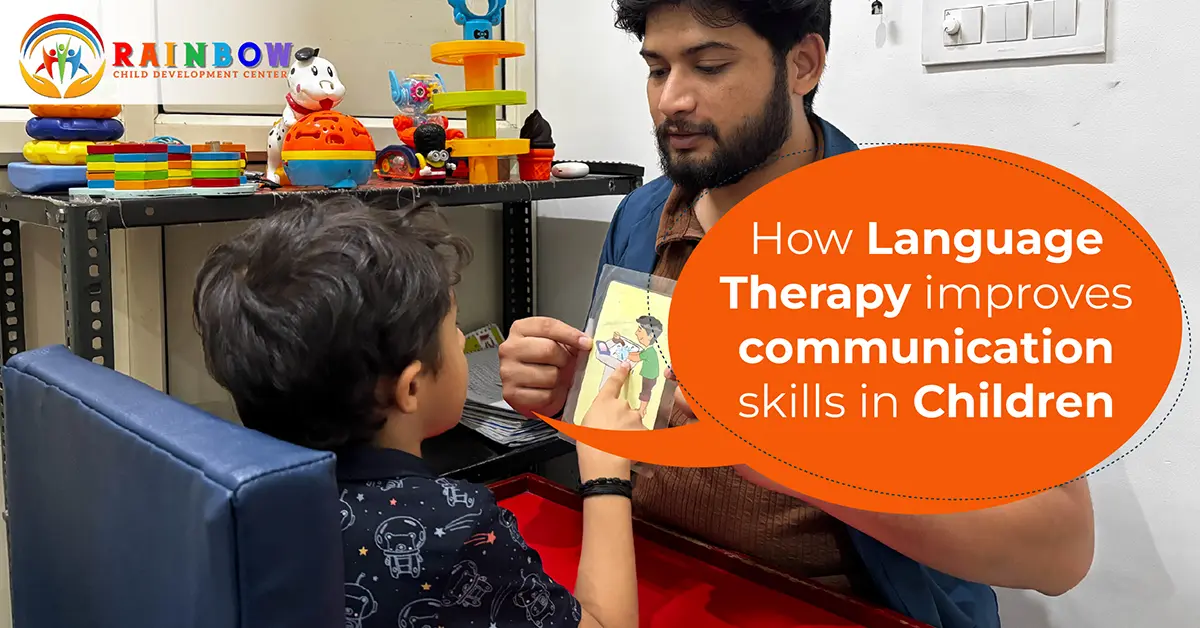
Language therapy works best when the child feels comfortable. That is why many sessions include toys, picture cards, books, movement, role-play, and simple games.
The child may feel as if they are playing, but each activity has a clear purpose.
It Helps Children Find the Right Words
Some children know an object but cannot name it. Others may use general words such as “this,” “that,” or “thing” because they cannot quickly recall the correct word.
A therapist may use familiar objects, photographs, matching games, or category activities to build vocabulary.
For example, the therapist may show pictures of an apple, banana, grapes, and orange, then ask the child to name them, describe their colour, and explain where they grow. This helps the child learn words in context rather than memorising them in isolation.
It Helps Children Speak in Full Sentences
A child may say, “Mummy water,” “dog run,” or “want a toy.” These phrases communicate a basic need, but they may not contain enough information.
The therapist helps the child expand them naturally.
For instance:
- “Dog run” becomes “The dog is running.”
- “Want toy” becomes “I want the blue toy.”
- “Mummy water” becomes “Mummy, please give me water.”
This kind of practice improves grammar and makes the child easier to understand.
It Improves Listening Skills
Communication is not only about speaking. Children also need to listen, process information, and respond correctly.
A therapist may begin with a simple direction such as, “Pick up the ball.” Later, the task may become, “Pick up the red ball and place it under the table.”
These activities help children manage classroom instructions, complete daily routines, and take part in group tasks.
Speech Therapy Techniques Used During Sessions
Therapists use different speech therapy techniques depending on the child’s needs.
For speech clarity, they may show the child where to place the tongue or how to move the lips. Mirrors can help children watch their mouth while making a sound.
For language development, the therapist may use:
- Storytelling activities
- Picture description
- Pretend play
- Repetition and modelling
- Question-and-answer games
- Sound practice
During speech therapy for kids, the therapist keeps the task simple enough to avoid frustration but challenging enough to encourage progress.
Common Speech Therapy Treatments for Children
Different children need different speech therapy treatments.
| Treatment | What It Supports |
|---|---|
| Articulation practice | Clearer pronunciation of sounds |
| Language intervention | Vocabulary, grammar, and sentence building |
| Play-based therapy | Communication during natural play |
| Social communication practice | Turn-taking, greetings, and conversation |
| Story sequencing | Memory, order, and expression |
| Parent guidance | Practice during normal home routines |
At Rainbow Childcare, therapy can focus on useful, everyday goals. A child may practise asking for help, answering a teacher, talking about their day, or joining another child’s game.
Benefits of Speech Therapy
The benefits of speech therapy often appear in small but meaningful changes.
A child who once cried when misunderstood may learn to say, “Help me open this.” A child who avoided group play may begin to greet classmates or answer simple questions.
Therapy may help children:
- Speak with better clarity
- Feel less frustrated
- Follow instructions more easily
- Take part in classroom discussions
- Build friendships
- Improve early reading and writing skills
- Express emotions more clearly
Progress may look different for every child, but even small improvements can make daily life easier.
How Long Does Speech Therapy Take?
Parents often ask, how long does speech therapy take? There is no single answer.
The timeline depends on the child’s age, the type of difficulty, the frequency of sessions, and how often the family practises at home. Some children show noticeable changes within a few months. Others need longer support.
Consistency matters more than speed. A child usually makes better progress when therapy goals also become part of daily life.
How Parents Can Help at Home
Parents do not need special materials to support language development.
Talk during normal routines. Name items while cooking. Ask the child what happened at school. Read short stories and pause to let the child predict what comes next.
When the child uses a short phrase, expand it without making them feel corrected.
If the child says, “Baby sleep,” reply, “Yes, the baby is sleeping in the bed.”
This gives the child a better sentence to copy.
When Should Parents Seek Help?
Parents may consider pediatric speech therapy when a child uses very few words, struggles to form sentences, speaks unclearly, avoids conversation, or becomes upset while trying to communicate.
A professional assessment does not always mean long-term therapy. It simply helps parents understand what the child needs and whether support would be useful.
Conclusion
Language therapy gives children practical tools to speak, listen, understand, and connect with others. It works through simple activities that match the child’s needs and daily life.
Knowing how language therapy improves communication skills in children allows parents to act early rather than wait for the problem to become more difficult. Rainbow Childcare can support families with child-focused therapy plans that build communication step by step.