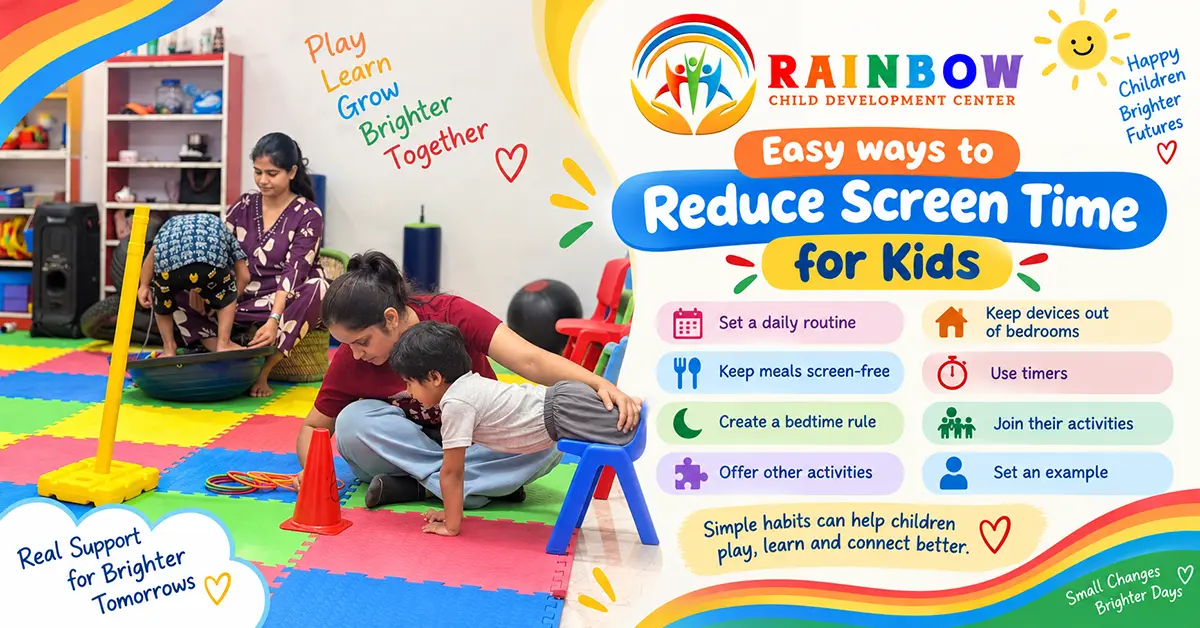
Phones, tablets, television and online classes have become a regular part of a child’s day. Screens can help with learning and entertainment, but long hours on devices may reduce outdoor play, disturb sleep and make it harder for some children to switch from digital activities to everyday routines. Parents often search for how to reduce screen time without arguments or sudden changes.
The goal does not have to be removing screens completely. A better approach is to set simple limits and give children enjoyable things to do away from devices. Rainbow offers services such as speech, occupational, ABA and sensory integration therapy for children with different developmental needs.
Easy Ways to Reduce Screen Time for Kids and Build Healthier Daily Habits
When parents look for how to get rid of screen time, an all-or-nothing rule often feels difficult to maintain. Children may use screens for homework, video calls or school projects, so the focus should be on unnecessary use.
Start by checking when your child uses a device most. Is it immediately after school, during meals or before bed? Once you know the pattern, you can replace part of that Screen time with another activity.
Healthline also suggests tracking screen use, creating screen-free periods and choosing hobbies as practical ways to cut unnecessary device use.
8 Simple Screen Time Rules Parents Can Try
- Set a daily routine: Fix clear times for homework, meals, outdoor play, family time and devices.
- Keep meals screen-free: Put phones and tablets away while eating.
- Create a bedtime rule: Ask children to stop using screens before sleep and follow the rule consistently.
- Offer other activities: Drawing, puzzles, cycling, music, crafts and board games give children something interesting to do.
- Keep devices out of bedrooms: Charge phones or tablets in a common area when possible.
- Use timers: A timer helps children know when their allowed screen session will finish.
- Join their activities: Children may leave screens more easily when parents play, read or go outside with them.
- Set an example: Children notice how often adults check their own phones.
For parents searching how to hack screen time, simple routine changes are more useful than trying complicated tricks. Make screens less convenient during family time and make offline activities easier to reach.
Can Too Much Screen Time Cause Headaches?
Parents sometimes ask, can too much screen time cause headaches? Long periods of screen viewing can contribute to eye strain and may trigger headaches or migraine attacks in some people. Screen glare, poor lighting and long periods without a visual break can also play a part.
If your child complains of headaches from screens or from screen time, encourage regular breaks rather than several hours of continuous viewing.
The 20-20-20 method is easy to recall: about every 20 minutes of viewing a screen, look at something 20 feet away for around 20 seconds. Balanced lighting in a room, avoiding glare, may also help with eye strain.
Parents searching how to stop headaches from computer screens should also check screen distance, posture, hydration and whether the child needs an eye examination. Frequent, severe or unusual headaches should be discussed with a healthcare professional.
Replace Screens With Activities That Match Your Child’s Interests
Cutting screen use becomes easier when children have something meaningful to do instead. A child who enjoys movement may prefer cycling, ball games or playground time. Another child may enjoy colouring, storytelling, building blocks or simple household tasks.
Children who need extra developmental support can also choose communication, movement, attention and everyday skills. Speech Therapy can help kids who have trouble speaking or communicating . Occupational Therapy can focus on the functional skills needed for day to day living . Rainbow also provides Language & Communication Therapy and Sensory Integration Therapy among its child development services.
Keep Screen Rules Practical for Different Children
Every child responds differently to changes. A sudden restriction can be especially challenging for a child who depends on a routine they are familiar with. The parents can decrease device time over time and explain what will happen next.
Children receiving Autism Spectrum Disorder support, ADHD Therapy or Behaviour Modification Therapy may benefit from clear routines and predictable transitions according to their individual
needs. Rainbow lists these developmental conditions and related therapy services as part of its child development support.
The same principle applies to children receiving Dyslexia Therapy, Down Syndrome Therapy or Cerebral Palsy Therapy. Screen rules should fit the child rather than following the same pattern for every family.
Related Child Development Support at Rainbow
Parents looking beyond screen habits may also want information about ABA Therapy, Special Education, Oral Placement Therapy and Psychological Assessment & Counseling.
For children who need support with play, social participation or communication, Rainbow also lists Play Group Therapy and services for Speech Sounds Disorder.
Movement-based needs may be supported through a Physiotherapist, while communication goals may involve Speech Therapy or Language & Communication Therapy.
Make Small Changes That Children Can Follow
Knowing how to reduce screen time is less about creating strict rules and more about building habits children can follow every day. Begin with one screen-free meal, shorten long viewing sessions and add more play or family activities.
At Rainbow children know what is expected and have fun alternatives, they are more likely to accept a routine. Be clear about the rules, be consistent, and change them as schoolwork or family needs change.