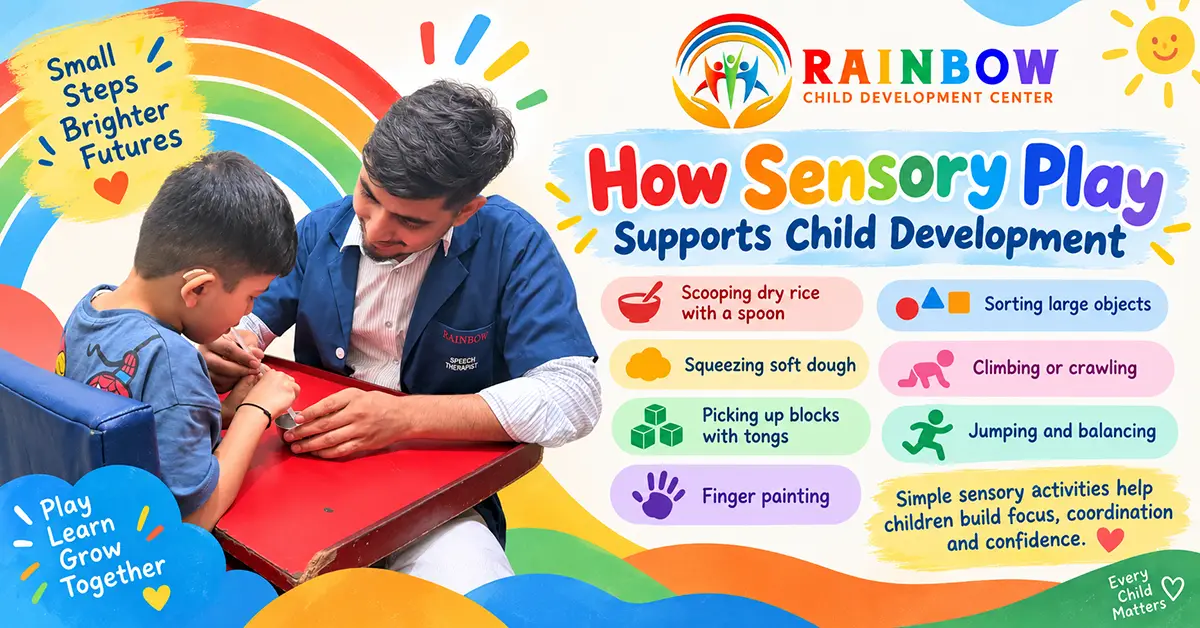
Children learn a lot through touch, sound, movement, smell, sight, and play. Before they can explain what they feel, they often understand things by trying them. They squeeze, pour, shake, climb, dig, listen, sort, and repeat. This is what makes sensory play useful during childhood.
A simple sensory experience can happen almost anywhere. Water play in the bathroom, sand at the park, dough at home, music, finger painting, or walking barefoot on grass can all give a child something new to feel and understand.
How Sensory Play Supports Child Development in Daily Learning and Play
To understand how sensory play supports child development, look at what happens during a simple activity.
A child pouring water into a cup is not just playing. They are watching the water move, keeping their hand still, judging distance, and learning what it is when the cup is full.
A child pressing play dough is feeling texture, using finger strength, and changing the shape with pressure. A child listening to different sounds is learning to notice what is loud, soft, near, or far away.
These small activities can help children build skills without making play feel like a lesson.
Sensory Play Can Build Hand and Body Movement
Many sensory activities for kids use the hands, fingers, arms, legs, and whole body.
Activities such as squeezing dough, picking up blocks, scooping rice, pouring water, drawing, or threading large beads can help children practise hand control.
Simple activities include:
- Scooping dry rice with a spoon
- Squeezing soft dough
- Picking up blocks with tongs
- Finger painting
- Sorting large objects
- Climbing or crawling
- Jumping and balancing
These movements can help children practise control and coordination.
Some children who find daily tasks difficult may also need Occupational Therapy. Children with movement concerns may need support from a Physiotherapist, depending on what their assessment shows.
Sensory Activities Can Help With Speech and Words
Children often pick up words faster when they can connect those words with something they can see or feel.
During sensory activities for toddlers, parents can use short words such as soft, hard, wet, dry, cold, warm, smooth, rough, full, empty, heavy, and light.
For example, while playing with water, you may say, “The water is cold.” While touching cotton, you can say, “This feels soft.”
There is no need to keep asking questions. Just talk while the child plays.
For children who need extra help with talking or understanding words, support may include Speech Therapy, Language & Communication, Speech Sounds Disorder support, or Oral Placement Therapy.
Sensory Games Can Help With Focus and Thinking
Some sensory games give children a reason to watch closely, remember, compare, and make choices.
You can hide safe toys in a box filled with soft material and ask the child to find them. You can pair up objects with similar textures, identify sounds, sort shapes or group items by colour.
These games can help children notice small differences.
They also teach simple cause and effect. Shake a bottle and it makes a sound. Press dough and it becomes flat. Pour water and the cup fills up.
A child learns by doing the same action again and seeing what happens.
Easy Sensory Activities for Toddlers and Older Kids
You do not need costly toys to plan good sensory activities.
Many useful ideas can be made from things already at home.
Try water pouring, play dough, safe sand play, bubbles, finger painting, music, clapping games, textured fabric, large blocks, drawing, or sorting household items by size.
For older children, you can try:
- Simple obstacle courses
- Gardening
- Baking
- Building blocks
- Craft work
- Sound guessing games
- Nature walks
- Matching games
Choose activities that fit the child’s age.
Small objects should stay away from young children because of choking risk. Water play also needs adult supervision.
Sensory Play for Children Who Need Extra Support
Every child develops differently. Some may need extra help with speech, learning, movement, behaviour, attention, or social skills.
Sensory play may sit alongside support for children receiving Autism Spectrum Disorder care, ADHD Therapy, Dyslexia Therapy, Down Syndrome Therapy, or Cerebral Palsy Therapy.
Other services may include ABA Therapy, Special Education, Behaviour Modification Therapy, and Psychological Assessment & Counseling.
These services are not the same. Each one has a different purpose.
Parents should choose support based on the child’s needs, age, daily problems, and professional assessment rather than selecting a therapy only by name.
Making Sensory Play Part of Everyday Life
Sensory play does not need a fixed time every day.
Bath time, eating, walking outside, helping in the kitchen, dressing, drawing, dancing, and listening to music can all become simple sensory moments.
Start with what your child enjoys.
If they like movement, try jumping, swinging, or dancing. If they enjoy touch, try soft fabric, dough, water, or sand. If they like sound, use music, clapping, or simple instruments.
Watch how the child responds and give them time.
At Rainbow, support can be planned around a child’s own needs through services such as Sensory Integration Therapy, Occupational Therapy, Speech Therapy, ABA Therapy, Special Education, and Play Group Therapy.