Each child matures in his or her own time. One child may talk later than other children the same age . Another may talk clearly but have difficulty holding a pencil , buttoning a shirt , eating with a spoon , or coping with loud sounds .
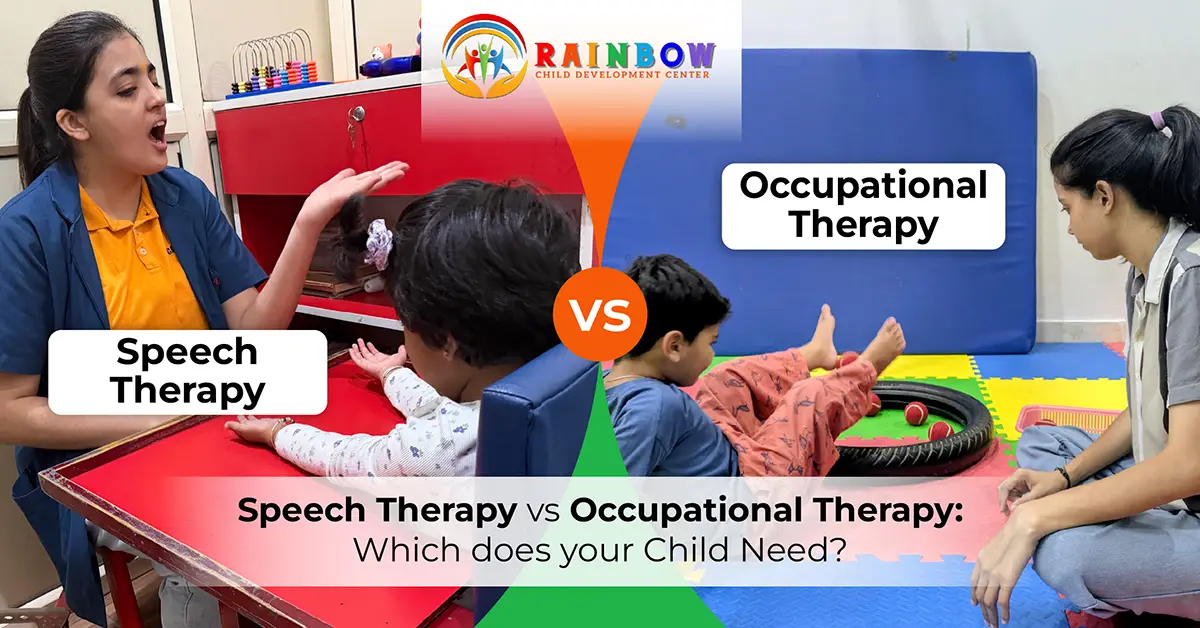
This is where parents might start looking into speech therapy vs occupational therapy. Both can help children but work on different skills. A speech therapist works mainly with speech, language, understanding and communication. Occupational Therapy works more with hand skills, movement, sensory needs, self-care, and everyday tasks.
At Rainbow Child Development Center, the starting point is understanding what the child finds difficult rather than putting every child into the same type of therapy.
Speech Therapy vs Occupational Therapy: Which Does Your Child Need? Key Differences for Parents
The easiest way to tell the difference is to look at your child's daily routine.
If your child knows what he or she wants but has trouble speaking, pronouncing words, answering questions, or understanding what others say, speech therapy might help.
If your child can communicate but finds writing, eating, dressing, playing, or handling different sounds and textures difficult, occupational therapy may be worth considering.
Some children have difficulties in both areas. In that case, they may work with both therapists.
What Is Speech Therapy for Children?
Parents often type speech therapy kya hai while looking for information online. In English, the phrase means what is speech therapy.
Speech therapy helps children with how they talk, understand words, use language and communicate with others.
You may want to meet a speech therapist if your child:
- Uses very few words for their age
- Has trouble saying certain sounds
- Speaks in very short sentences
- Finds questions difficult to answer
- Does not easily follow spoken directions
- Gets upset when people cannot understand them
- Has trouble talking and playing with other children
Speech problems are not always the same. One child may have trouble saying a particular sound, while another may understand words but find it hard to make sentences. This is why the therapist first needs to understand the exact problem.
Language & Communication Therapy may also help children who have trouble understanding or using language in everyday situations.
What Do Children Do in Speech Therapy?
A therapy session does not have to feel like a classroom lesson. With younger children, much of the work can happen through toys, pictures, books, sounds, and games.
Different speech therapy exercises can include naming familiar objects, repeating sounds, answering simple questions, completing sentences, telling short stories, or practising words during play.
A therapist working on the "k" sound might use words such as cat, cup, car, and key. If a child needs help with vocabulary, they can look at a picture and name the people, objects or actions they see.
Parents also look for speech therapy pictures when they are looking for activities to do at home. Picture cards are good for naming, matching, storytelling and word practice. However, random activities found online may not target the reason behind a child's speech difficulty.
For some children, Oral Placement Therapy may be considered when work on oral movements forms part of their individual therapy plan.
What Is Occupational Therapy for Children?
Occupational therapy is not about preparing a child for a job. In children's therapy, the word "occupation" refers to everyday activities.
These can include holding crayons, eating, getting dressed, playing, writing, using scissors, and taking part in school activities.
An occupational therapist may work with a child who has trouble with:
- Pencil grip and handwriting
- Using a spoon or fork
- Buttons, zips, and shoelaces
- Cutting paper with scissors
- Hand-eye coordination
- Balance and body control
- Sitting and completing an activity
- Touching certain materials or textures
A child who reacts strongly to noise, touch, movement, clothing, or food textures may also be assessed for Sensory Integration Therapy.
When Should You Meet a Speech Therapist?
Speech differences become easier to notice as children start communicating more.
You might notice that other people have difficulty understanding your child. Your child may know an answer but struggle to put it into words. They may point instead of speaking or use the same few words repeatedly.
These signs do not automatically mean something is wrong. But when speech or language difficulties regularly affect communication at home, school, or during play, it makes sense to discuss them with a qualified speech therapist.
Starting with an assessment also prevents parents from relying only on general speech therapy exercises that may not match their child's needs.
When Can Occupational Therapy Be Useful?
Think about the small things your child does every day.
Can they hold a crayon comfortably? Can they feed themselves? Do they avoid things like sand or paint or clay or other textures? Do simple dressing tasks take much longer than expected?
These everyday observations can tell parents a lot.
Occupational therapy may work on the exact skills that make these tasks difficult. For example, a therapist may work on hand strength before expecting better handwriting.
Children in ABA Therapy, Special Education or Behavior Modification Therapy may also have sensory or motor needs. These therapies serve different purposes and should not automatically replace others.
Can a Child Need Both Therapies?
Yes. There is no rule that a child must choose only one.
Take a child who has trouble asking for toys and also avoids touching certain play materials. Speech therapy can work on words, requests, and conversation. Occupational therapy can work on the sensory or motor difficulties that make play harder.
This is why looking at the whole child matters. Two children of the same age can have completely different needs even when parents notice similar behaviour.
Rainbow Child Development Center offers Speech Therapy, Occupational Therapy, ABA Therapy, Language & Communication Therapy, Special Education, Behaviour Modification Therapy, Sensory Integration Therapy, and Oral Placement Therapy for different areas of child development.
How Much Does Occupational Therapy Cost?
Parents searching how much does occupational therapy cost will find different prices because there is no standard fee for every clinic or every child.
Costs will vary depending on the length of the session, the therapist’s experience, the initial assessment, the number of sessions required and the child’s therapy plan.
Before making a decision, parents can ask about the assessment fee, how long the session will last, how many sessions are recommended, progress checks and whether there are activities that need to be continued at home.
Speech Therapy or Occupational Therapy: Where Should Parents Start?
Start with the problem you see most often.
If your concern is talking, pronunciation, vocabulary, understanding language, or communication, speak with a speech therapist.
If the main problem involves writing, hand movements, dressing, eating, coordination, or sensory difficulties, ask about occupational therapy.
If both areas are affected, your child may need both assessments.
At Rainbow Child Development Center, parents can discuss their child's everyday difficulties and understand which type of therapy fits those concerns. The aim is simple: find the skill that is making daily life difficult and work on that skill in a way the child can use at home, at school, and while playing.