A child starts crying in a supermarket because you said no to a chocolate bar. Another child covers their ears, drops to the floor, and screams because the lights are bright, the music is loud, and too many people are around.
Both situations may look similar, but they are not always the same.
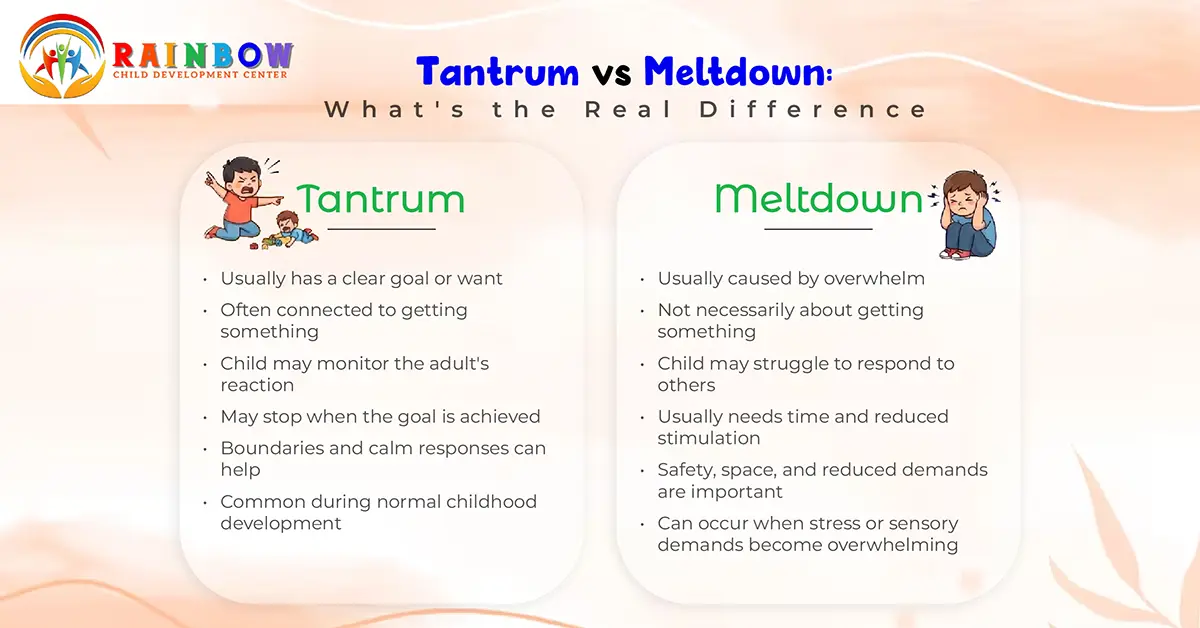
Understanding Tantrum vs Meltdown: What’s the Real Difference? helps parents understand what their child needs in the moment. Tantrums usually start because a child either wants something, wants to avoid something or is feeling frustrated. A meltdown is more likely when a child has reached their limit and can no longer cope with what is happening around them.
Rainbow Child Development Center works with children who have different communication, sensory, learning, and behavioural needs. Looking at what happens before a child's reaction can often tell parents more than the reaction itself.
Tantrum vs Meltdown: What's the Real Difference and Why Does It Matter?
The easiest way to tell the difference is to look at the reason behind the behaviour.
Tantrums often have a clear purpose. A child may want a toy, extra screen time, another snack, or to avoid getting ready for school. They may cry or shout because they hope the adult will change their answer.
A meltdown is different. A child may have trouble with noise, touch, frustration, tiredness, a change in routine, or too many instructions at once.
With a meltdown you might give the child what they wanted before but that may not stop the reaction. They need time and less demand before they can settle.
Why Do Tantrums Happen?
Tantrums are common in young children. Small children are still learning how to wait, hear "no," share, stop a fun activity, and tell adults what they are feeling.
A child may have a tantrum because:
- They want something immediately
- A parent has set a limit
- They do not want to leave a place
- They are tired or hungry
- They cannot explain what they want
- They are upset about a change
During some tantrums, children keep checking the adult's reaction. They may pause, look at the parent, and then start crying again.
Parents can keep their response simple. Stay calm, keep the boundary clear, and avoid turning the situation into a long argument.
What Is an Emotional Meltdown?
An emotional meltdown can happen when a child has had more than they can handle.
The child may cry very hard, scream, push things away, hide, cover their ears, hit out, or stop responding to people around them.
Sometimes the trigger is obvious. At other times, several small things build up during the day.
A noisy classroom, poor sleep, hunger, uncomfortable clothes, a change of teacher, difficulty with homework, or a crowded journey home can all add stress.
When a meltdown starts, long explanations usually do not help. Keep the child safe and reduce what is happening around them.
What Is an Autistic Meltdown?
An autistic meltdown can happen when an autistic child becomes overloaded.
Some children with Autism Spectrum Disorder are very sensitive to sounds, lights, smells, touch, movement, or sudden changes. Others may become upset when they cannot explain what they need.
For example, a child may cope well at school all day but have a meltdown after coming home. The child may have spent hours dealing with noise, instructions, social situations, and changes.
That does not mean the child is behaving badly at home. They may simply have reached the point where they cannot manage any more.
How to Help a Child With Autism Calm Down
Parents often search for how to help a child with autism calm down because every child reacts differently.
Start with the surroundings.
Lower the noise if you can. Move away from a busy area. Speak less. Give the child some space. If they have a familiar object that helps them feel settled, let them use it.
Try not to ask questions such as "Why are you doing this?" while the child is still very upset.
Wait until they are calmer before talking about what happened.
For some children, Sensory Integration Therapy may be useful when sounds, textures, movement, or other sensory experiences regularly make daily life difficult.
Can Speech Difficulties Lead to Frustration?
Yes. Imagine knowing what you want but not being able to say it clearly.
A child with a Speech Sounds Disorder may become frustrated when parents, teachers, or other children cannot understand them.
This does not mean every child with speech difficulty will have meltdowns. But poor communication can make an already difficult situation harder.
Some children may also be advised to attend Oral Placement Therapy when their therapist finds a specific need related to oral movements, speech, or feeding.
Giving children simple choices or pictures can sometimes make it easier for them to tell adults what they need.
When Can Behaviour Support Be Useful?
If the same difficult behaviour happens again and again, parents can start by noticing what happens just before it.
Behavior Modification Therapy can be helpful if a child’s behavior is causing difficulties with home life, school, play or everyday routines.
Kids in ADHD Therapy may also need help with waiting, attention, impulsive reactions, or frustration.
When parents are unsure whether behaviour is linked to stress, fear, emotions, or another issue, Psychological Assessment & Counseling may help give a clearer picture.
Can Sensory Overload Be the Trigger?
For some children, yes.
Think about a busy wedding. There may be loud music, flashing lights, unfamiliar food, many people talking, hugs from relatives, and a change in the child's normal routine.
For a child who is sensitive to these things, the experience can become too much.
A child may cover their ears, try to leave, cry, or become very restless before the meltdown begins.
Learning these early signs can give parents a chance to offer a quiet break before the child reaches their limit.
What Do Cathartic and Catharsis Mean?
The word cathartic means something that gives a person a chance to release strong feelings.
For example, a person may say that crying after a stressful week felt cathartic.
To define catharsis, it means the release of strong emotions that have built up over time.
A child's meltdown should not automatically be called catharsis, though. Many children feel tired, upset, or drained after a meltdown rather than relieved.
The more useful question is: what made things too much for the child?
Different Children Need Different Help
Not every behaviour has the same cause, so the same type of therapy will not suit every child.
A child receiving Dyslexia Therapy may need help with reading and learning.
A child receiving Down Syndrome Therapy may need support with communication, movement, learning, or daily skills.
Cerebral Palsy Therapy may involve work related to movement, posture, communication, or everyday activities.
A Physiotherapist may help a child with strength, balance, movement, or mobility.
Some children may enjoy Play Group Therapy when they need practice playing, sharing space, and interacting with other children.
Rainbow Child Development Center brings different child development services together so parents can look at the child's actual needs rather than choosing therapy from a label alone.
What Should Parents Do After a Meltdown?
Do not rush into a lecture once the child stops crying.
Give them time to recover.
Later, think about what happened before the meltdown. Was your child hungry? Was the room noisy? Did a plan change suddenly? Were they unable to explain something?
Write down repeated triggers if you notice a pattern.
Sometimes small things, like giving notice in advance, maintaining a familiar routine, providing quiet breaks, or using shorter instructions can help make difficult situations easier.